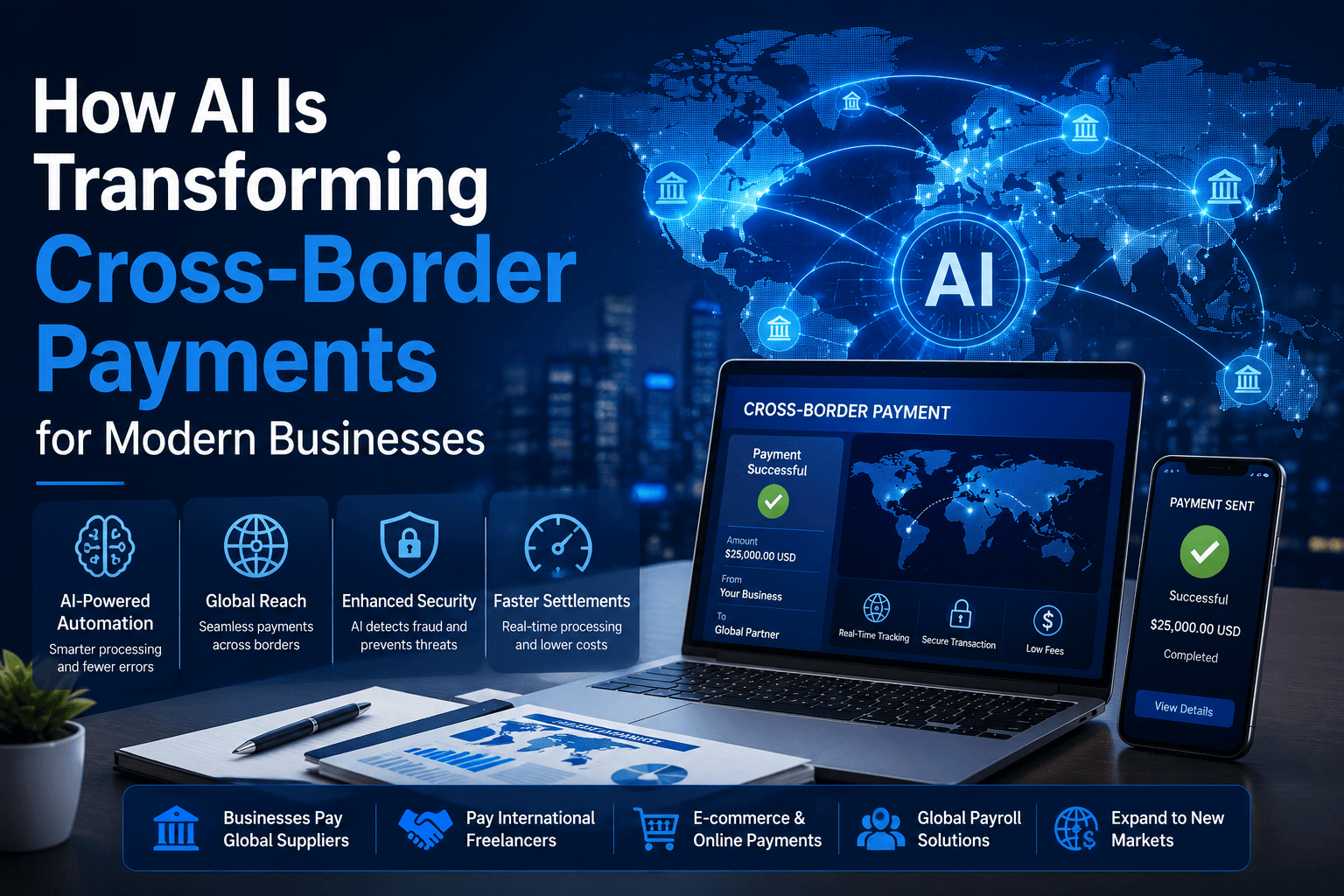
Global business has changed significantly over the last decade. Companies are no longer limited to serving customers within their home country. Today, businesses source materials from international suppliers, hire remote employees across multiple regions, expand into new markets, and serve customers around the world. As a result, cross-border payments have become an essential part of everyday business operations.
However, sending money internationally is often more complicated than processing domestic payments. Different banking systems, multiple currencies, foreign exchange fluctuations, regulatory requirements, and settlement delays can increase both costs and operational complexity. Finance teams must also ensure payments reach the correct beneficiaries while maintaining compliance with international regulations.
Fortunately, advances in artificial intelligence (AI) are transforming how businesses manage international transactions. AI-powered payment platforms can automate compliance, detect fraud in real time, optimize payment routing, and improve foreign exchange decisions. Instead of relying on manual processes, businesses can now process cross-border payments faster, more securely, and with greater transparency.
In this article, we'll explore how AI is reshaping cross-border payments, where businesses benefit the most, and what to consider when choosing a modern international payment solution.
What Are Cross-Border Payments?
Cross-border payments refer to financial transactions where the sender and recipient are located in different countries. These payments may involve different currencies, banking networks, payment regulations, and foreign exchange conversions.
Businesses use cross-border payments for a variety of purposes, including:
Paying international suppliers
Managing global payroll
Settling invoices with overseas partners
Receiving payments from international customers
Processing marketplace payouts
Moving funds between regional offices
Unlike domestic transfers, international payments often require additional verification, foreign exchange conversion, compliance checks, and coordination between multiple financial institutions. Without the right payment infrastructure, these processes can become slow, expensive, and difficult to manage.
Modern payment providers simplify these challenges by offering transparent pricing, faster settlement, automated reporting, and real-time payment visibility.
Why AI Is Reshaping Cross-Border Payments
Artificial intelligence is becoming one of the most important technologies in global payments. Instead of simply processing transactions, AI continuously analyzes payment data to improve efficiency, reduce risks, and help finance teams make better decisions.
Real-Time Fraud Detection
Cross-border payments are attractive targets for financial fraud because they involve multiple countries and banking systems. AI continuously monitors transaction behavior and identifies unusual payment patterns that may indicate fraudulent activity. Unlike traditional rule-based systems, AI adapts over time by learning from previous transactions, helping businesses detect threats more accurately while reducing false alerts.
Smarter Compliance
International payments must comply with regulations such as Know Your Customer (KYC), Anti-Money Laundering (AML), and sanctions screening. Completing these checks manually can delay payments and increase administrative work.
AI automates many of these compliance processes by verifying customer information, identifying potential risks, and screening transactions against global regulatory databases. This helps businesses improve compliance while accelerating payment approvals.
Intelligent Payment Routing
Not every international payment follows the same banking route. AI evaluates available payment corridors and recommends the most efficient route based on cost, speed, and reliability.
This allows businesses to reduce settlement times, lower transaction fees, and improve payment success rates without requiring manual intervention from finance teams.
Better Foreign Exchange Decisions
Currency fluctuations directly impact the cost of international business payments. AI analyzes historical exchange rates and market trends to help businesses make more informed foreign exchange decisions.
For organizations regularly processing high-value international payments, working with an institutional OTC desk providers can provide additional advantages. These specialized services help businesses execute large foreign exchange transactions with improved liquidity, competitive exchange rates, and personalized settlement support while minimizing the market impact often associated with sizeable currency conversions.
How Businesses Are Using AI in Cross-Border Payments
Paying International Suppliers
Manufacturers, wholesalers, and retailers frequently purchase goods from overseas suppliers. Delayed or inaccurate payments can interrupt production schedules, increase operational costs, and damage supplier relationships.
AI helps automate business invoice verification, monitor payment progress, detect unusual transactions, and predict settlement delays before they affect operations. This enables finance teams to maintain stronger supplier relationships while improving payment efficiency.
Managing Global Payroll
As remote work continues to grow, businesses increasingly employ professionals across multiple countries. Processing salaries and contractor payments manually every month can be both time-consuming and error-prone.
AI-powered payment platforms simplify international payroll by validating beneficiary information, automating compliance checks, and ensuring payments are processed accurately in the appropriate currency. This reduces administrative work while delivering a better payment experience for employees and contractors worldwide.
Marketplace and Ecommerce Payments
Online marketplaces and ecommerce businesses process thousands of international transactions every day. Unlike traditional businesses that occasionally send overseas payments, these platforms must manage customer payments, seller payouts, refunds, and settlements across multiple countries and currencies.
For example, an ecommerce platform selling products globally may receive payments from customers in Europe, North America, and Asia while paying merchants and service providers in different regions. Managing these payment flows manually can increase operational costs and delay settlements.
AI helps simplify these operations by automatically routing payments through the most efficient banking networks, detecting failed transactions before they occur, and providing real-time visibility into payment performance. This enables businesses to process payments faster while improving the customer and merchant experience.
Choosing the Right Cross-Border Payment Provider
Selecting the right payment provider plays a significant role in the success of international business operations. Beyond competitive pricing, businesses should evaluate providers based on their technology, global reach, compliance capabilities, and payment infrastructure.
When comparing providers, consider whether they offer:
Support for multiple countries and currencies
Transparent foreign exchange pricing
AI-powered fraud detection and risk monitoring
Automated KYC, AML, and sanctions screening
Real-time payment tracking
Integration with ERP and accounting systems
Access to institutional OTC desk services for large-value foreign exchange transactions
Dedicated customer support for international payment operations
A modern payment provider should not only facilitate international transfers but also help businesses improve efficiency, strengthen security, and support long-term global growth.
Conclusion
Cross-border payments have become a critical component of modern business as organizations expand into international markets and manage increasingly complex financial operations. While traditional payment methods often involve delays, manual processes, and regulatory challenges, artificial intelligence is transforming how businesses move money across borders.
From real-time fraud detection and automated compliance to intelligent payment routing and foreign exchange optimization, AI enables businesses to process international transactions with greater speed, accuracy, and security. Combined with reliable payment infrastructure and institutional services such as OTC providers for large-value foreign exchange requirements, businesses can reduce operational costs while improving cash flow and payment efficiency.
As global commerce continues to evolve, organizations that invest in AI-powered cross-border payment solutions will be better positioned to streamline international transactions, strengthen financial control, and support sustainable global expansion.
 6 min read