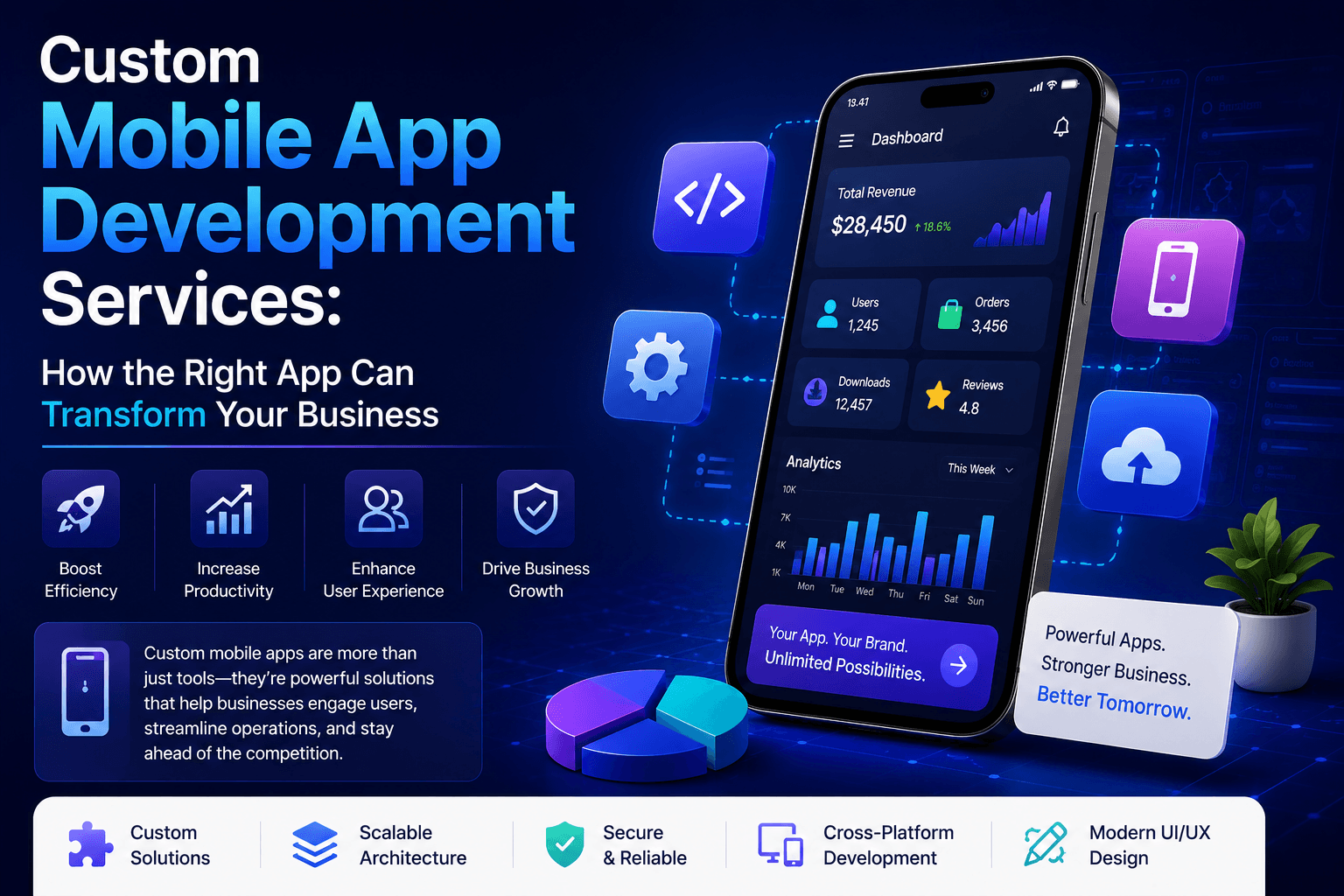
Your customers are on their phones right now, deciding who earns their business. If your company doesn't have a mobile app — or has one that feels clunky and generic — you're handing that decision to a competitor. That's the real case for custom mobile app development services: not a buzzword, just a practical response to where your customers already are.
A custom app isn't a smaller version of your website. It's a direct channel to your customers, built around how your business actually works instead of the limits of a template. At Creatd, this is the exact problem we help businesses solve every day.
What Makes an App “Custom,” and Why Does It Matter?
Custom mobile app development means your application is designed and coded from the ground up around your specific business logic, user base, and growth plans — as opposed to a no-code builder or pre-packaged template stretched to fit.
The difference shows up fast:
| Custom-Built App | Template / No-Code App |
|---|
Functionality | Matches your exact workflows | Limited to built-in features | Performance | Optimized for your use case | Often slows down at scale | Security | Hardened specifically for your data | Shared, generic vulnerabilities | Branding | Fully your own identity | Recognizably templated | Growth Runway | Scales with your business | Requires a costly rebuild later |
|
|---|
Businesses that plan to grow — not just launch and see what happens — almost always come out ahead with custom development, even though the upfront investment is higher.
Our Experience
[Replace this paragraph with a short, specific example from your own work — a client name (if permitted), the problem they had, and the result. Example: “When we built [Client]'s delivery app, their support tickets dropped by X% within the first month because customers could finally track orders in real time.”]
What a Complete App Development Service Should Actually Include
Plenty of agencies say “we build apps.” Far fewer walk you through the entire lifecycle. Here's what a genuinely professional service looks like from start to finish:
Discovery & Strategy. Before any code is written, a good team maps your business goals, your users, and your competitors — so the app solves a real problem instead of guessing at one.
UI/UX Design. The single biggest driver of whether users stay or delete your app within a week. Good design is invisible; it just feels easy.
Native iOS & Android Development. For apps where performance and deep OS integration matter most — camera-heavy apps, AR features, hardware access — native code is still the gold standard.
Cross-Platform Development with Flutter. One codebase, two app stores. For most businesses, this cuts both cost and time-to-market substantially without a noticeable quality trade-off.
Progressive Web Apps (PWA). An installable, app-like experience straight from the browser — no app store approval needed, ideal for a faster go-to-market.
QA & Testing. Across devices, screen sizes, and OS versions, before your users ever find the bugs for you.
App Store Launch Support. Submission, compliance, and store-listing optimization — the unglamorous work that determines whether people actually find your app.
Ongoing Maintenance. Operating systems update constantly. An app that isn't maintained doesn't stay good for long.
Where Custom Apps Deliver the Clearest ROI
E-commerce — personalized product feeds and push notifications that bring customers back without extra ad spend.
Healthcare — booking, telehealth, and patient record access that reduces no-shows and admin overhead.
Logistics & Delivery — live tracking and route optimization that cuts fuel and time costs.
Finance — secure, compliant apps that customers trust with real money.
Education — interactive, on-the-go learning that keeps engagement higher than desktop platforms ever could.
How to Vet a Development Partner
Before choosing a team for your app development project, a few things are worth checking:
A real portfolio across iOS, Android, and cross-platform work — not just screenshots
Design capability that stands on its own, not an afterthought to engineering
Clear, proactive communication throughout the build
Maintenance and support included in the conversation from day one
Experience with offline-first architecture, since connectivity is never guaranteed
Frequently Asked Questions
How much does custom mobile app development cost?
It depends on complexity, platform, and feature set. A simple MVP costs far less than a feature-rich, enterprise-grade app. A free consultation is the quickest way to get a number that actually applies to your project.
How long does it take to build a custom app?
Most projects run a few months from discovery to launch. A lean MVP can move faster if speed to market matters more than a full feature set on day one.
Should I choose Flutter or native development?
Choose Flutter if you want both platforms launched efficiently on one budget. Choose native if your app depends on cutting-edge performance or deep hardware integration.
Do I really need an app if I already have a mobile-friendly website?
A website informs. An app engages — with push notifications, offline access, and a speed a browser can't match. That difference shows up directly in retention.
The Bottom Line
The businesses winning in mobile aren't the ones with the flashiest app — they're the ones whose app actually fits how their customers behave. That's the entire case for custom mobile app development services: less guesswork, less rebuilding later, more return on what you spend now.
If you're ready to build an app around your business instead of the other way around, talk to Creatd's app development team for a free consultation. Pair it with our UI/UX design or chatbot services to round out your product from day one.
 5 min read